
When the Power Goes Out, Everything Goes With It
There is a version of every outage story that nobody reads about. It is the one where nothing happened when utility power failed, the backup generated started, the transfer switch engaged, the facility held its operational baseline, and the duty manager spent a quiet Friday doing exactly what they were hired to do. Patients kept their appointments. Hotel guests slept through it. The on-call technician had nothing to log.
That story does not make the news. But it is the story we are in the business of writing.
This edition of Power Failure Fridays spans two industries, healthcare and hospitality, and two discrete operational failures that, while divergent in context, share an identical root cause: the decision, deliberate or by organizational default, not to invest in resilience before continuity was tested.
Power Failure Friday Series 4: When Power Stops, Care Stops
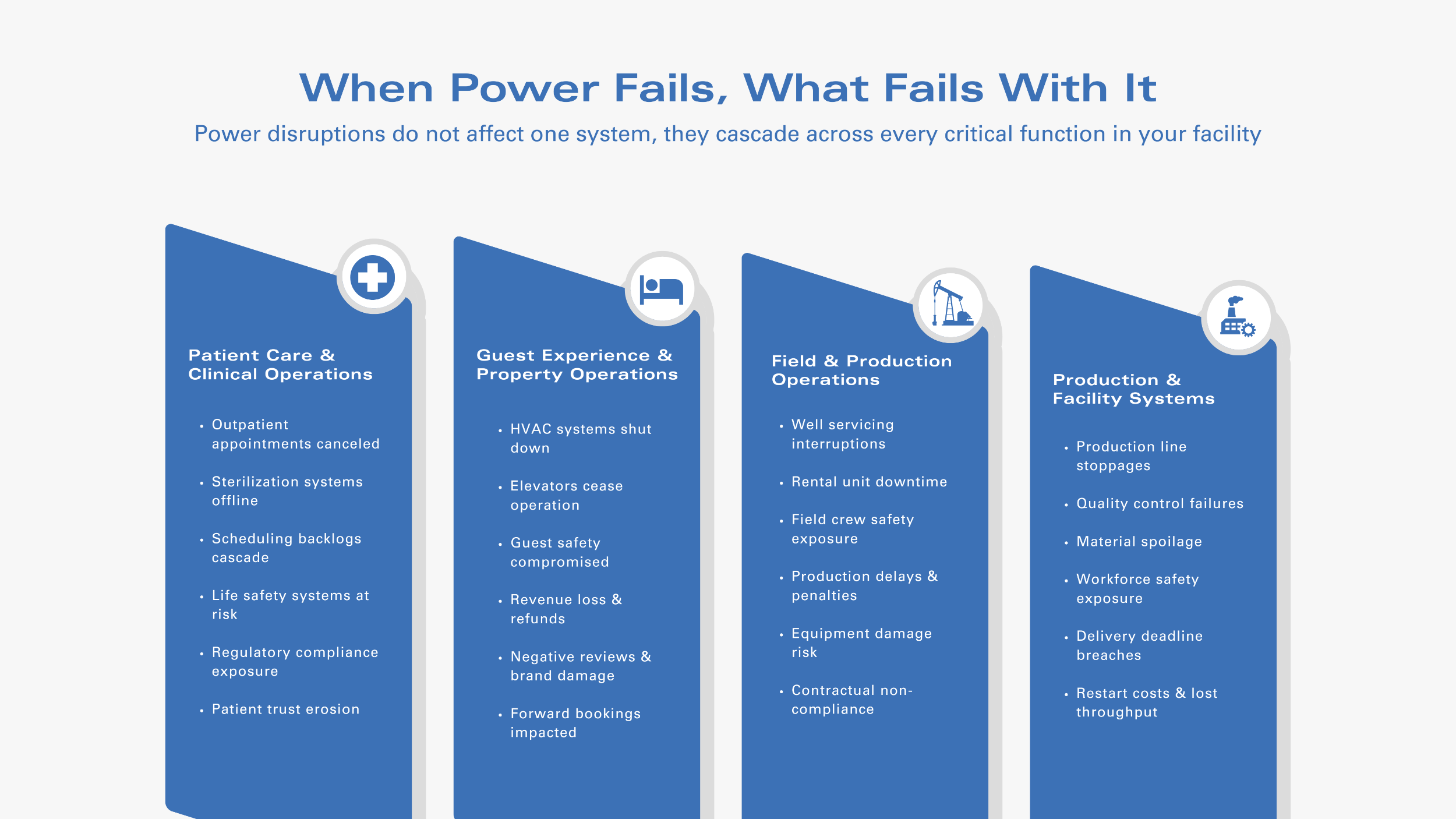
A hospital experienced an unexpected power disruption that cascaded across its operational infrastructure. Outpatient appointments were canceled en masse. Sterilization systems went offline. Scheduling backlogs compounded across the subsequent days, and patients who required timely intervention did not receive it.
Root Cause: Somewhere, Something Broke
Even when mission-critical systems operate behind standby power, the operational envelope of a modern healthcare facility extends well beyond those protected loads. Outpatient services, sterilization infrastructure, and administrative functions are routinely left exposed. The consequence: short-duration disruptions that engineering teams classify as non-critical generate scheduling debt that takes weeks to unwind and patient experience outcomes that are anything but minor.
What This Means
The readiness gap here was not dramatic. No intensive care unit was compromised. But framing the event as minor misreads the risk calculus. In healthcare, the margin between operationally inconvenient and clinically consequential is narrower than most capital planning exercises account for. Canceled procedures create downstream liability exposure. Sterilization failures introduce regulatory complexity. Scheduling backlogs erode patient trust in ways that are slow to recover and difficult to quantify on a balance sheet.
The readiness framework that mitigates this exposure is consistent across facility types: critical and extended-operational equipment supported by standby power; generator capacity sized to actual facility load, not estimated load; transfer switches maintained and exercised under realistic conditions; emergency systems verified by discipline, not assumption.
A Life Safety Upgrade That Could Not Wait
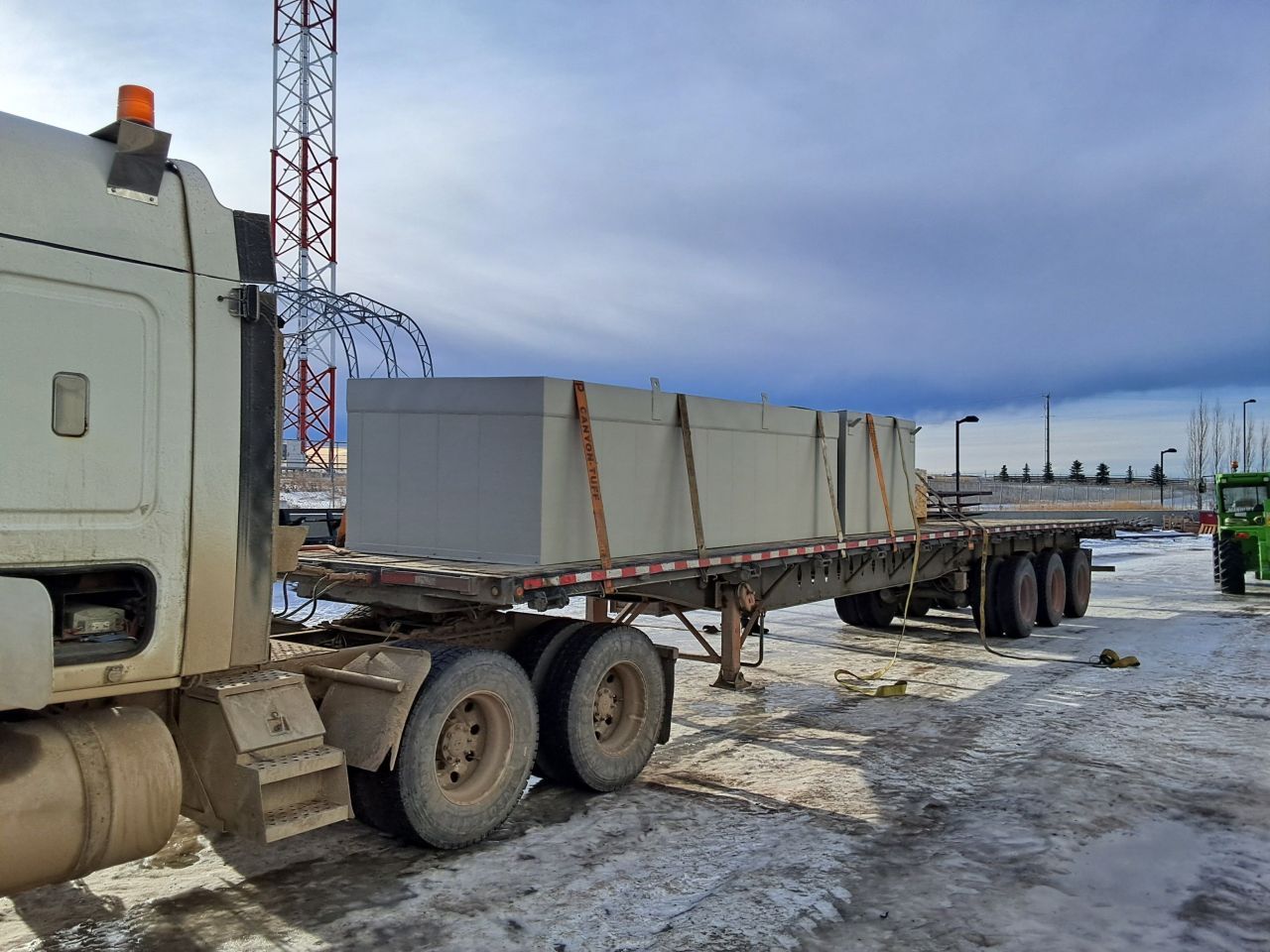
A healthcare facility in Southern Manitoba required a Fire and Life Safety power system upgrade with a fixed commissioning deadline. The application was unambiguous in its criticality: backup power for the life safety systems of a personal care home. There was no acceptable delay scenario.
A delivery variance threatened to compromise the project timeline. Our enclosure fabricator responded by opening their facility on a Saturday solely to facilitate transport loading a decision that reflected not contractual obligation, but operational commitment. When the unit arrived on-site, our Calgary service team assumed ownership of the final mile. Our technician executed two consecutive days of final connections and commissioning-grade testing to ensure the system was fully operational at the moment the client required it.
No extensions. No workarounds. No compromise on specification.
Project Highlights:
- Application: Personal care home fire and life safety systems
- Challenge: Delivery delay threatening a non-negotiable commissioning deadline
- Response: Saturday fabrication + two days of field commissioning by our Calgary team
- Engineering: Custom "skintight" enclosure designed to stringent specification
- Outcome: On-time delivery, zero compromise on specification
Power Failure Series 3: When Comfort Disappears Overnight
Root Cause: Somewhere, Something Broke
The property lacked any on-site standby power capability. Restoration required the full logistics cycle of sourcing, mobilizing, and delivering a temporary generation unit; a process spanning more than 24 hours. In a summer heatwave, the absence of HVAC and elevator access is not a comfort issue. It is a duty-of-care issue, with potential liability implications that extend well beyond the cost of a single night's refunds.
What This Means
The financial consequences of this event are intuitive room refunds, accelerated rate concessions, operational overtime, and near-certain impact on forward booking velocity once negative reviews enter the distribution channel. The less visible cost is the erosion of brand equity. In hospitality, guest loyalty is predicated on a foundational assumption: that the property will provide a safe, comfortable, and reliable environment regardless of external conditions. A 24-hour outage during a heatwave does not merely disrupt that assumption, it actively inverts it.
For asset owners and operators, the calculus is straightforward: the annualized cost of standby power infrastructure is a known, plannable capital expenditure. The cost of a single high-profile outage event accounting for revenue loss, remediation, brand recovery, and potential regulatory scrutiny, is not.
Keeping Residents Comfortable Without Interruption
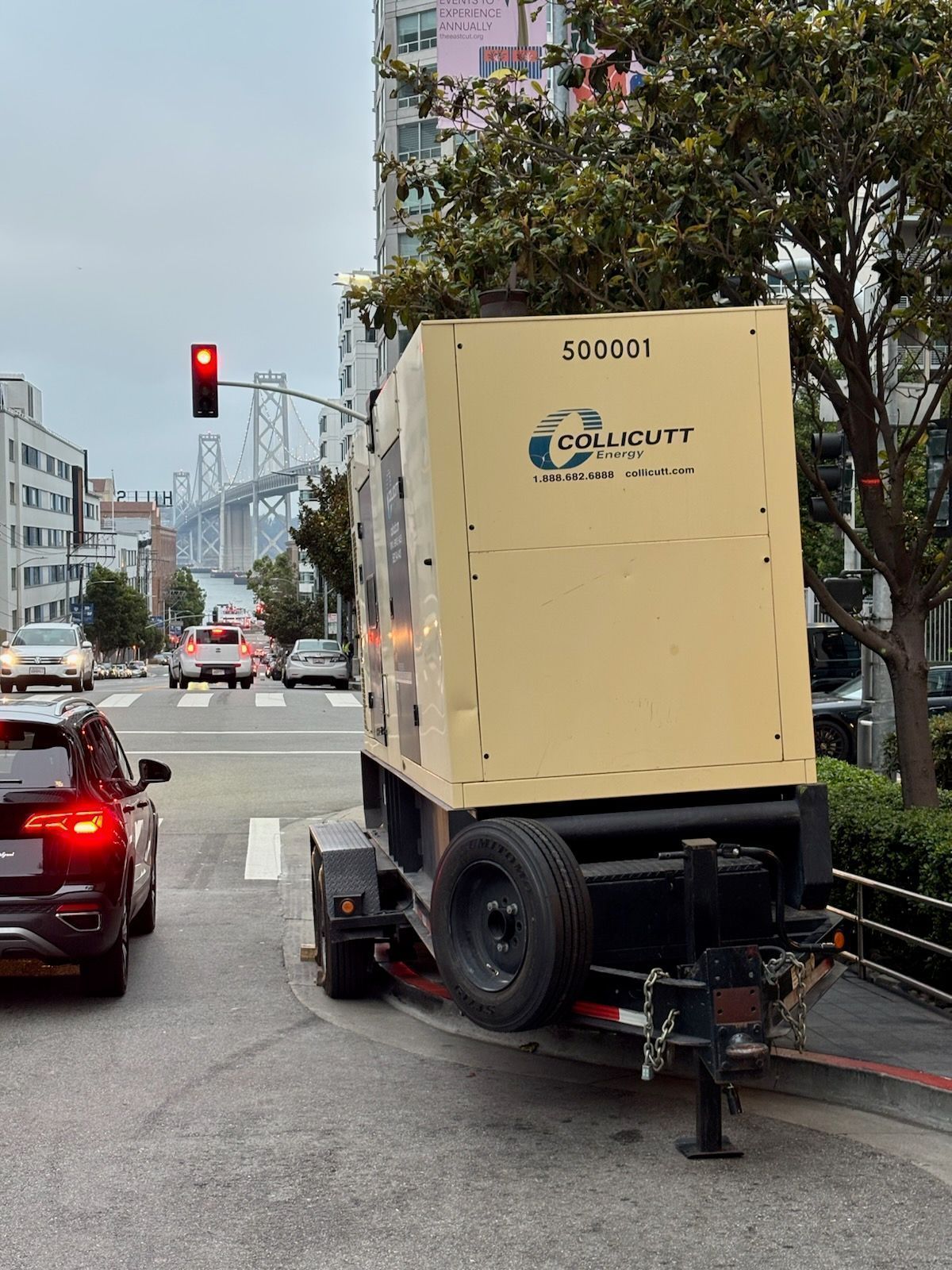
A residential hotel property in California required a planned coolant service on its primary systems necessary preventive maintenance, but presenting a structural challenge: how does a facility execute planned downtime on critical infrastructure without disrupting the residents currently occupying the building?
The answer was proactive power planning. The facility engaged ahead of the maintenance window, brought in temporary power, and partnered with Collicutt to ensure continuity across the service period. Guests experienced no disruption. Building systems remained operational. With the Bay Bridge visible in the background, it was the kind of engagement that looks seamless from the outside because every operational variable had been addressed before the work began.
That is the distinction between reactive and proactive power strategy. One version generates case studies. The other generates nothing which is precisely where sophisticated operators want to be.
The Common Thread: Preparation as Strategic Posture
A hospital and a hotel. Two industries with different regulatory environments, different stakeholder matrices, and materially different consequences when systems fail. But at the organizational level, both events resolve to the same strategic failure: standby power was not treated as a capital priority until continuity was already compromised.
In the healthcare case, the gap was granular. Life-critical systems were protected; the broader operational envelope was not. The implicit assumption that a partial outage affecting non-critical loads is an acceptable risk understates the true cost of continuity loss. Scheduling debt, sterilization downtime, and patient experience degradation represent real and measurable liabilities that do not appear on a line item until after the event.
In the hospitality case, the gap was fundamental. No on-site standby power capability meant that restoration depended entirely on third-party logistics a dependency with a 24-hour resolution time during conditions that created genuine guest welfare exposure. The question for any executive team reviewing that event is not "what went wrong?" but "what was the organizational rationale for not having a generator on-site?"
What Operational Readiness Actually Looks Like
Across both industries, the technical checklist items that separate resilient facilities from vulnerable ones are not sophisticated engineering innovations. They are disciplined operational commitments: critical and extended-load systems supported by rated standby power; generation capacity sized against measured demand rather than design-phase estimates; automatic transfer switches maintained, tested under load, and documented; emergency systems verified through structured protocols, not periodic assumptions.
What the Collicutt engagements in Southern Manitoba and the San Francisco Bay Area demonstrate is that resilience is not only an infrastructure question; it is a partnership and execution question. A Saturday fabrication run to preserve a commissioning deadline. Two days of field testing to ensure a life safety system was commissioned correctly. Temporary power deployed ahead of a planned maintenance window to eliminate guest impact. These are the operational decisions that determine whether an event is a case study or a footnote.
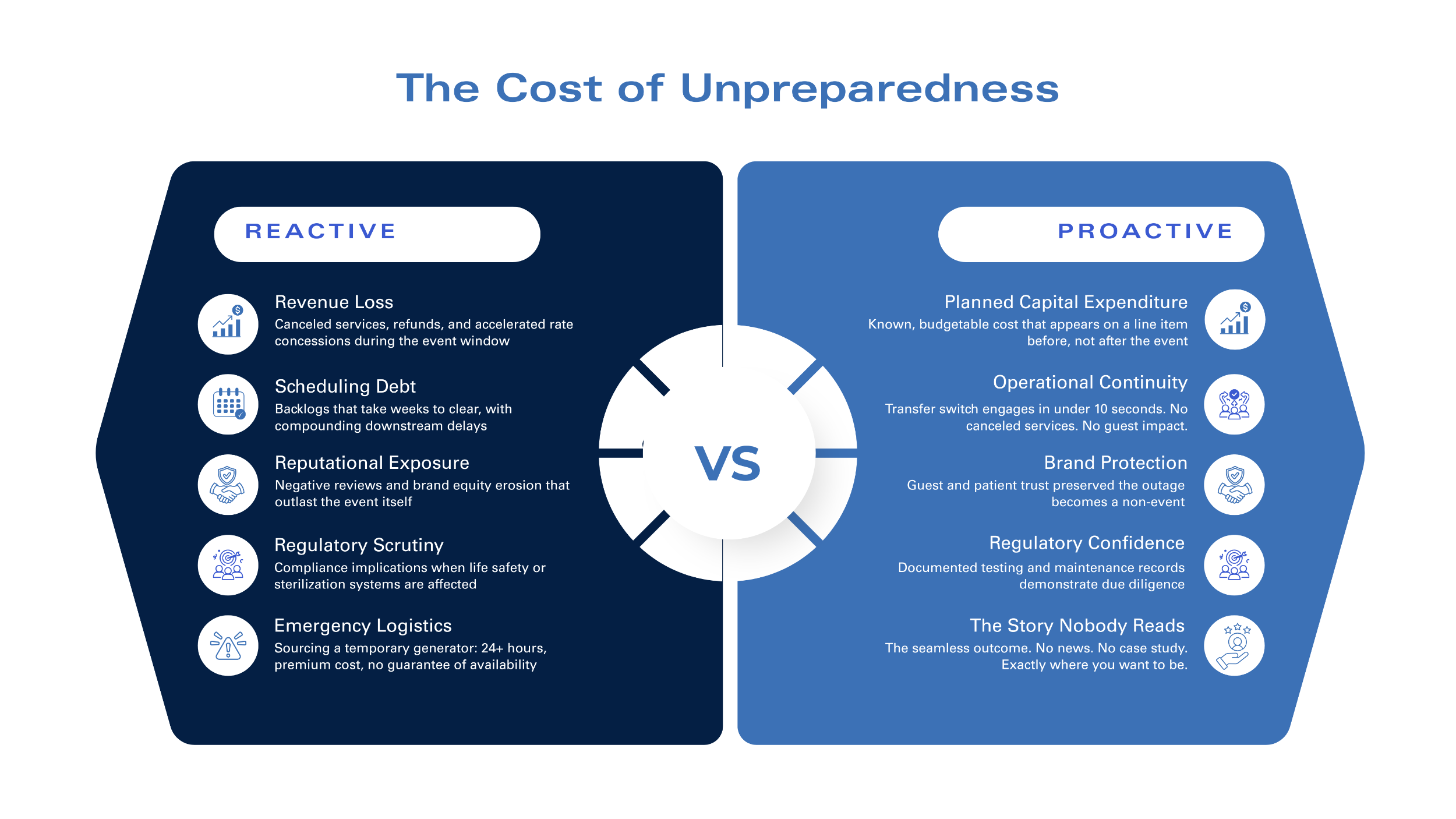
Downtime is not an inconvenience at the organizational level. In healthcare, it affects care delivery and introduces clinical and regulatory risk. In hospitality, it erodes the trust relationship that underlies guest loyalty and forward revenue. In both sectors, the cost of unpreparedness measured in revenue, liability exposure, reputational capital, and recovery investment consistently exceeds the cost of the standby infrastructure that would have prevented the event.
Your Facility Should Not Be the Next Case Study
Whether you operate in healthcare, hospitality, or any critical-load environment where operational continuity is non-negotiable let's have a substantive conversation about what power resilience looks like for your organization.
collicutt.com · · 888.682.6888
April 23, 2026
