
Alberta Had Its Wettest June in Over 60 Years
Central Alberta is underwater, and the rain is not done.
As of June 24, 2026, the Edmonton region had received 203 mm of rain for the month, approaching the all-time June record of 216.5 mm, set in 1914. According to Global News, on average Edmonton receives 69.9 mm of rain in June. During the weekend of June 21 and 22, 2026, the city received more than its entire monthly average in a single two-day period.
The consequences were severe and widespread. According to CBC News, stormwater systems across Edmonton and surrounding municipalities were overwhelmed, with overland flooding, sewer backups, and waterlogged roads affecting Edmonton, Beaumont, St. Albert, Wabamun, Stony Plain, Lac Ste. Anne County, and Beaver County. Emergency alerts were issued across the region, with residents urged to reduce non-essential water use while infrastructure crews responded.
According to Global News, by June 22 the North Saskatchewan River was flowing at roughly 1,050 cubic metres per second through Edmonton, approximately double the speed recorded 48 hours earlier. EPCOR confirmed that pumps were actively deployed to move stormwater to other parts of the system to balance capacity.
The rainfall did not stop there. On June 24, 2026, Environment Canada issued a special weather statement projecting an additional 30 to 60 mm of rainfall across central Alberta from Friday, June 27 through Sunday, June 29, with the possibility of a further system following early the next week. Environment Canada noted that the ground was already fully saturated from the previous weekend’s storm, increasing the risk of overland flooding, washouts, and infrastructure disruptions from any additional precipitation. According to Global News, several river basins, including the North Saskatchewan, Red Deer, Battle, Beaver, Athabasca, Peace, and Hay rivers, remained above normal levels as of June 24, 2026.
Atlas Copco WEDA Electric Submersible Pumps
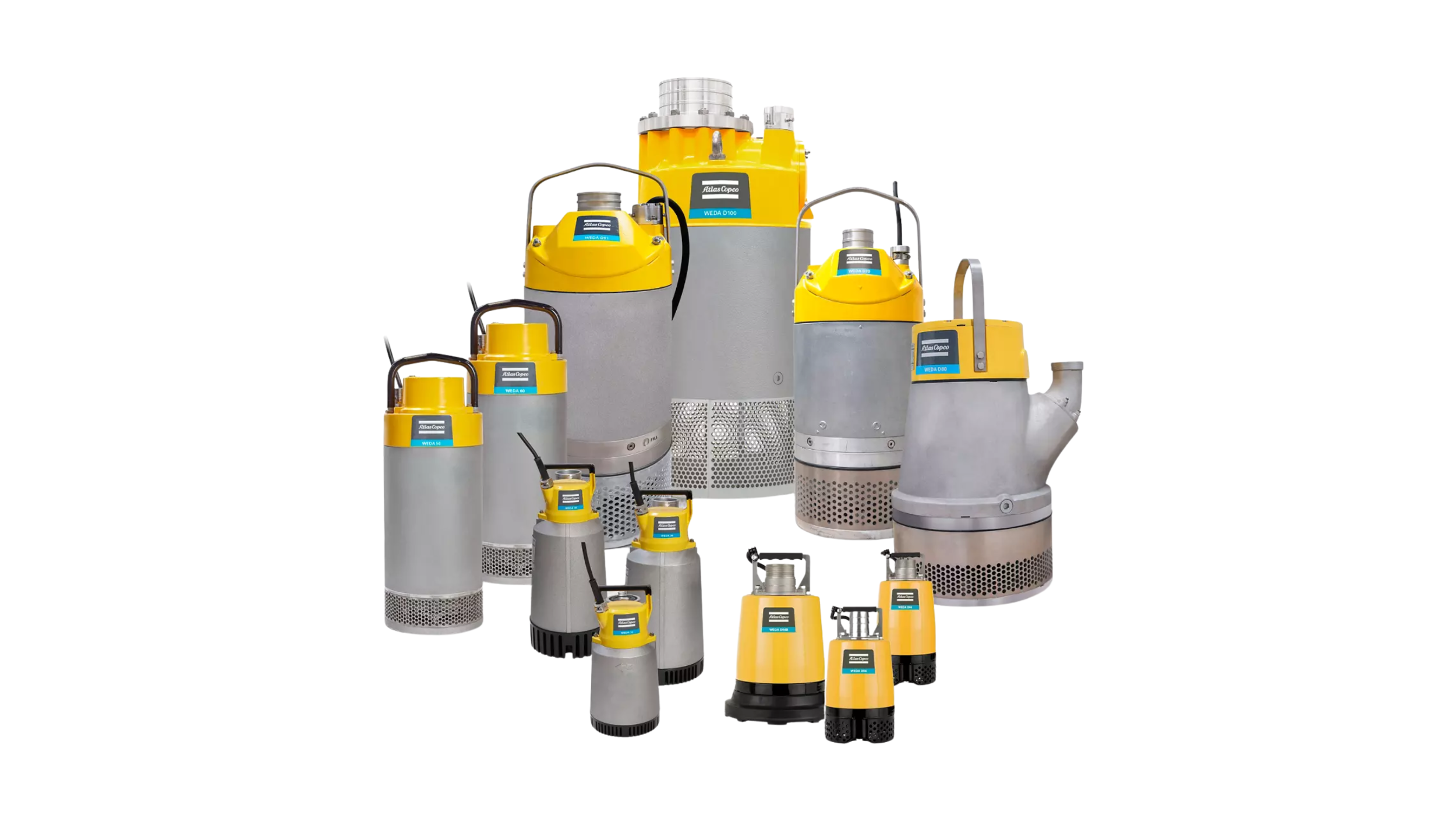
The WEDA series is Atlas Copco’s range of electric submersible dewatering pumps, designed for drainage, sludge, and slurry applications across construction, industrial, emergency, and maintenance environments.
The range covers flow rates from approximately 60 GPM up to 4,780 GPM, depending on the model, with maximum head reaching up to 482 feet. The lineup is organized into three families based on what the pump needs to handle:
WEDA D : Drainage
These pumps handle clean water or water with small solid particles, and are designed for general dewatering, groundwater control, and construction site drainage. They use a top-discharge design and can handle water with specific gravity up to 1,100 kg/m³, with solids passing up to 12 mm depending on the model.11 Built-in motor protection and a plug-and-play design make them fast to deploy, which matters when water is rising and time is limited.
WEDA S : Sludge
When the water contains larger solids or thicker, more viscous material, the kind of mixed debris that accumulates in flooded excavations or the outflow from industrial processes, the WEDA S handles it. These pumps use a bottom side discharge and a high-chrome cast-iron impeller of vortex type, and can pass solids up to 50 mm depending on the model. Specific gravity handling extends up to 1,200 kg/m³.
WEDA L : Slurry
The toughest family in the range. These pumps handle semi-liquid slurry mixtures with the most demanding solid content, fine particles of cement, coal, or similar media mixed with water. The WEDA L handles specific gravity up to 1,500 kg/m³ and solid sizes up to 60 mm depending on the model.
Across all three families, every WEDA pump includes a built-in starter and motor protection system, optional automatic level control, and adjustable wear-resistant rubber diffusors with hardened high-chrome impellers. The seal system is designed to be serviced at the job site. The pumps are also approximately 40 percent lighter than comparable products,15 which Atlas Copco notes makes them particularly well suited for rental use, exactly the scenario that widespread flooding creates.
Where they fit in an Alberta flooding event: WEDA D units are the right tool for dewatering a flooded excavation, clearing a construction site, or moving groundwater away from a foundation. WEDA S units are the answer when that same flood water has been carrying silt, debris, or industrial residue. When you need a pump that can go directly into the water source and keep running, the WEDA line is designed for that.
Atlas Copco PAC Diesel-Driven Pump Assemblies
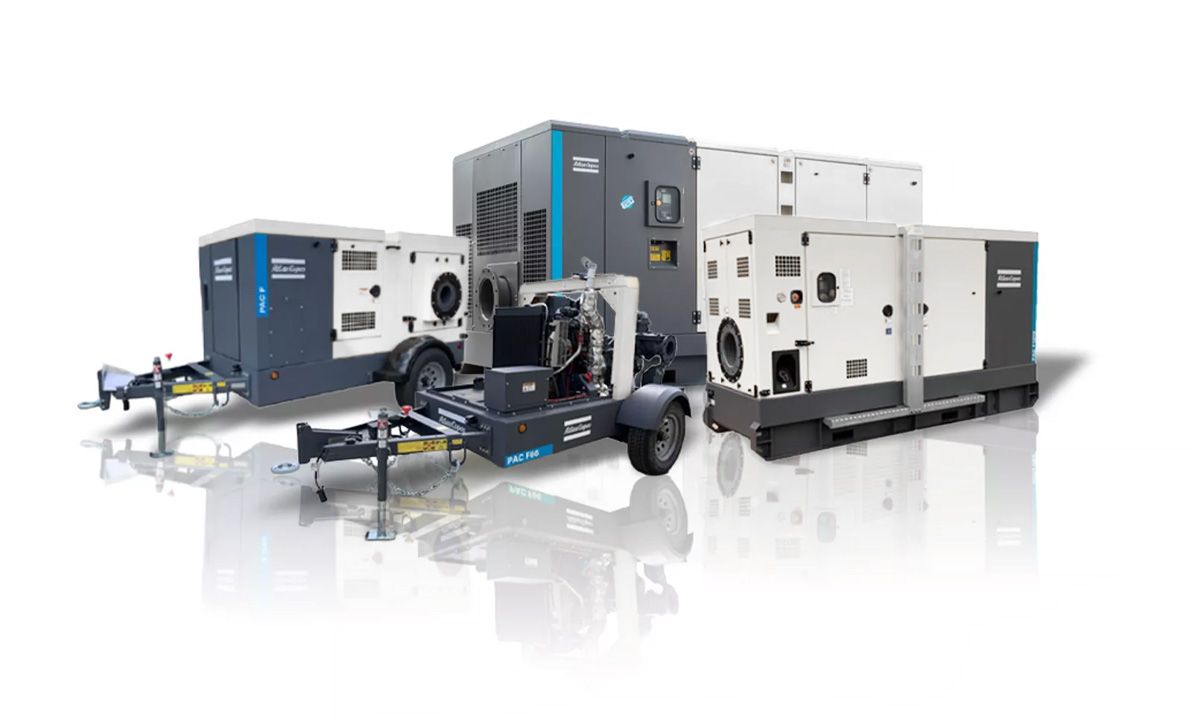
PAC Flow Series (PAC F)
The Flow Series is built for high-volume liquid transfer, municipal bypass pumping, and large-scale dewatering where moving as much water as possible is the priority. The PAC F1212, one of the units in our lineup, is capable of flows up to 9,100 GPM with a maximum head of 269 feet. It handles solids up to 3.5 inches in size and uses an enclosed 17-inch impeller with 74 percent efficiency at best efficiency point (B.E.P.). A diaphragm vacuum pump provides fast priming. The swing-door design gives direct access to the pump internals for rapid service without full disassembly.
The Flow Series is the answer when a stormwater system has backed up and needs supplemental bypass capacity, when a sewer lift station has reached capacity and needs a diesel backup pump, or when large-scale agricultural or infrastructure flooding requires continuous high-volume pumping over an extended period. It runs on diesel, meaning it is not dependent on electrical infrastructure that may itself be compromised during a flooding event.
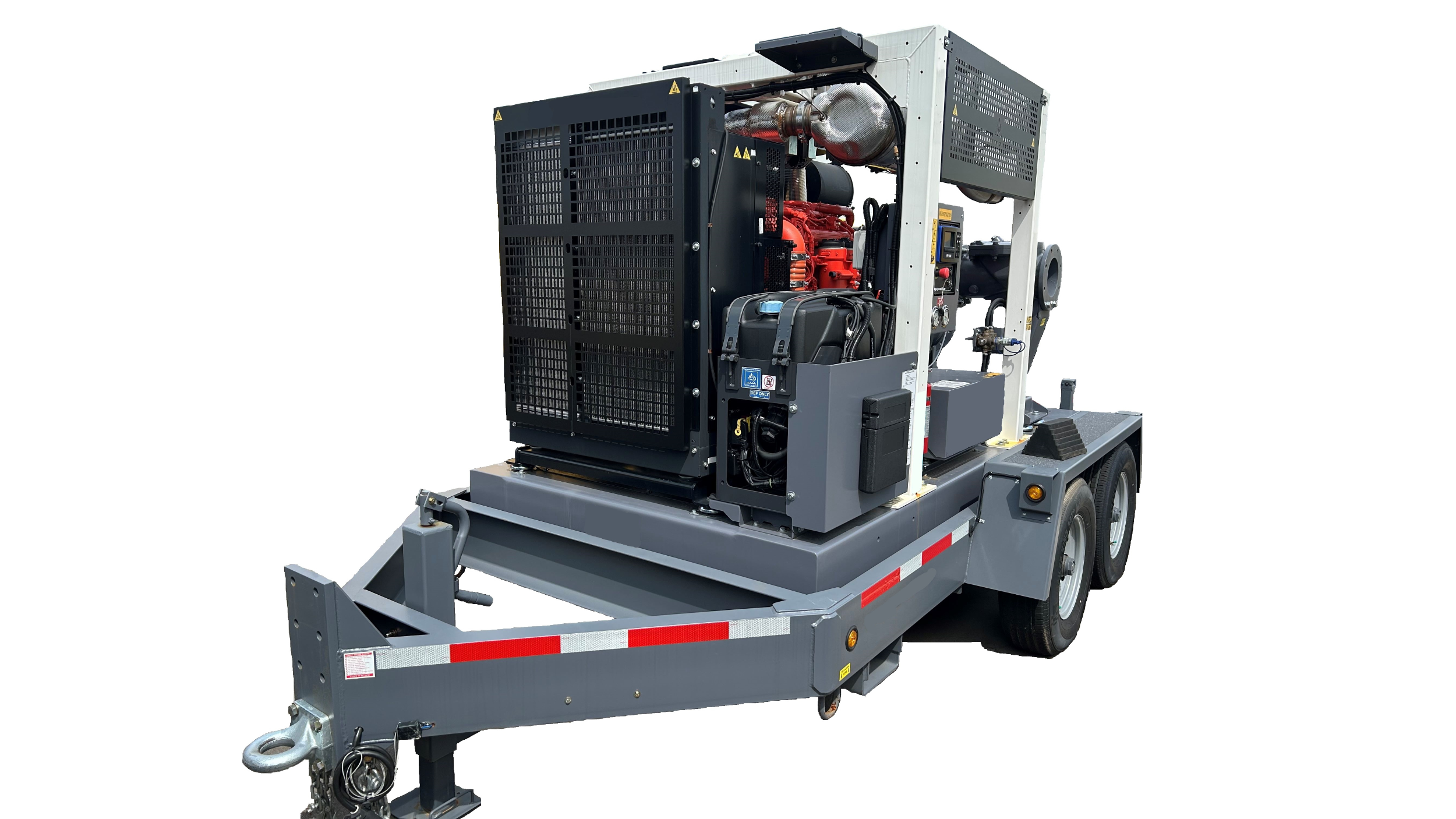
PAC High Head Series (PAC H)
The High Head series is designed for applications where water must be moved to significant elevation or over long distances, rather than purely for volume. The PAC H108, the largest unit in the line, is powered by a 325 horsepower diesel engine, delivers up to 360 feet of head, and flows up to 6,400 GPM. It handles spherical solids up to 3.5 inches. The PAC H64 delivers a maximum head of 500 feet with flows up to 1,950 GPM and handles solids up to 3 inches. These units are designed for demanding industrial environments including oil and gas, quarrying, surface mining, and large municipal or construction applications where head requirements would overwhelm a standard centrifugal pump.
All PAC units are self-priming, which eliminates the need for manual priming and means a faster start from a cold deployment, an important practical advantage when you are responding to a flooding event rather than a planned project.
Pump Wet Ends
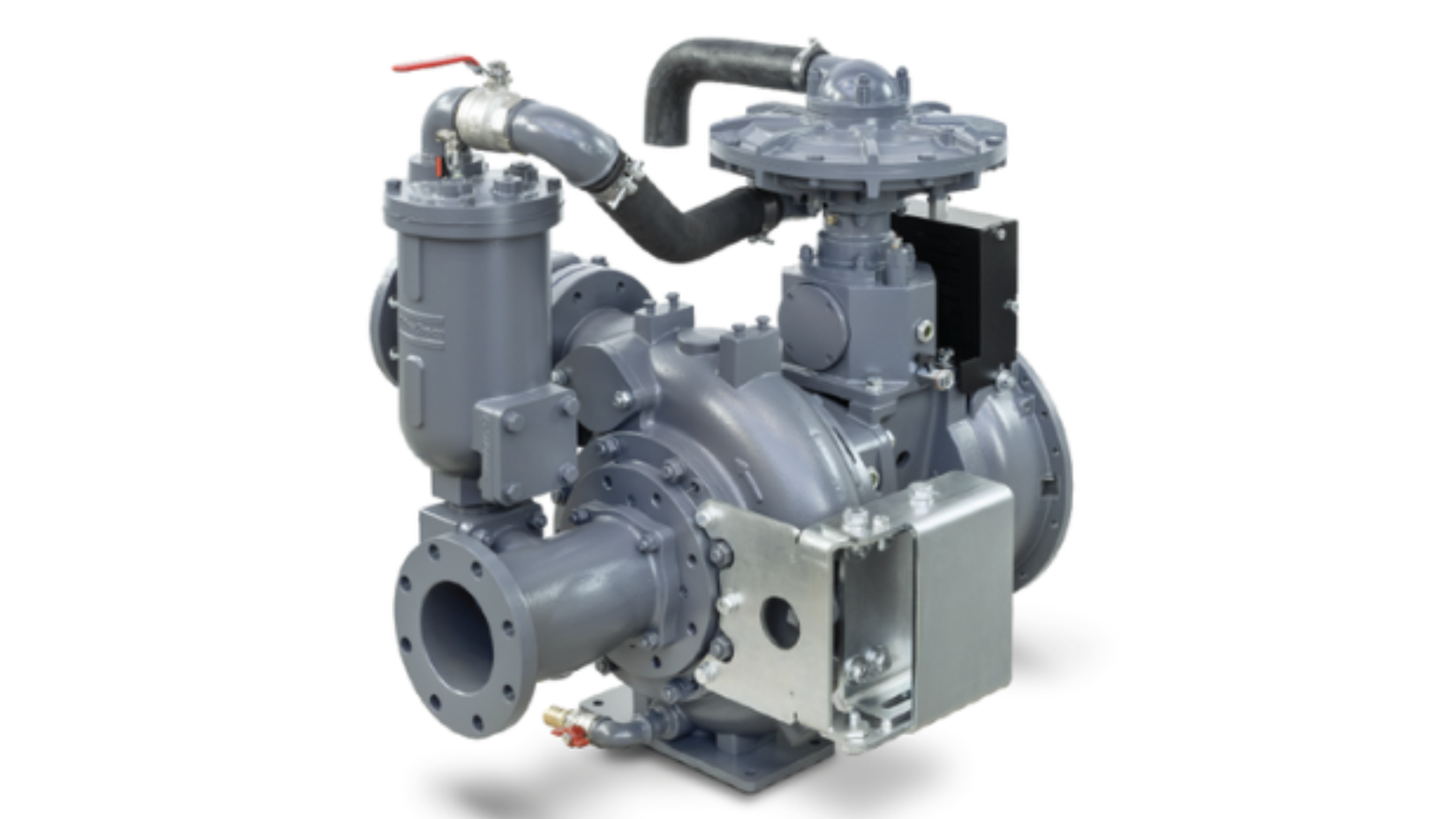
The ADC F1212 wet end in our lineup is the hydraulic heart of the F1212 pump assembly, the impeller housing, volute, and associated wear components that are in direct contact with the fluid being pumped. For operations that already have a drive unit and need to replace a worn wet end, or that are configuring a custom pump package, the wet end is the component that determines flow capacity, head, and solids handling. Serviceable wear components in the wet end design are what makes long-term operation in abrasive or debris-laden conditions economical.
Choosing the Right Tool
Flooding events in Alberta do not present a single, uniform challenge. A flooded excavation on a residential construction site calls for a different solution than a municipal lift station bypass or a large-scale agricultural drainage operation. The right answer depends on the volume of water, how contaminated or debris-laden it is, how far or how high it needs to travel, and whether electrical power is available.
If you are managing an active situation and are not certain which equipment fits, that conversation is exactly what our team is set up for. We have been supporting engine-driven power and fluid management solutions in Alberta since 1986, and our team understands both the equipment and the operating conditions that Alberta sites present.
Get Ahead of the Next System
With more rainfall forecast for central Alberta and river basins across the province already running above normal, the window to stage equipment ahead of the next event is short. Rental availability tightens quickly when a flooding event is widespread, reaching out before the rain arrives gives you options that waiting until after will not.
Contact to check pump availability and get the right equipment staged for your site:
Marty Hudon
Account Manager, Collicutt Energy Services
Cell: 403.596.4348
Local: 403.309.9250
Toll-Free: 888.682.6888
July 15, 2026
Categories:
