
Big Power Needed Now and Why Data Centre Growth Is Forcing a Fundamental Shift in Power Strategy
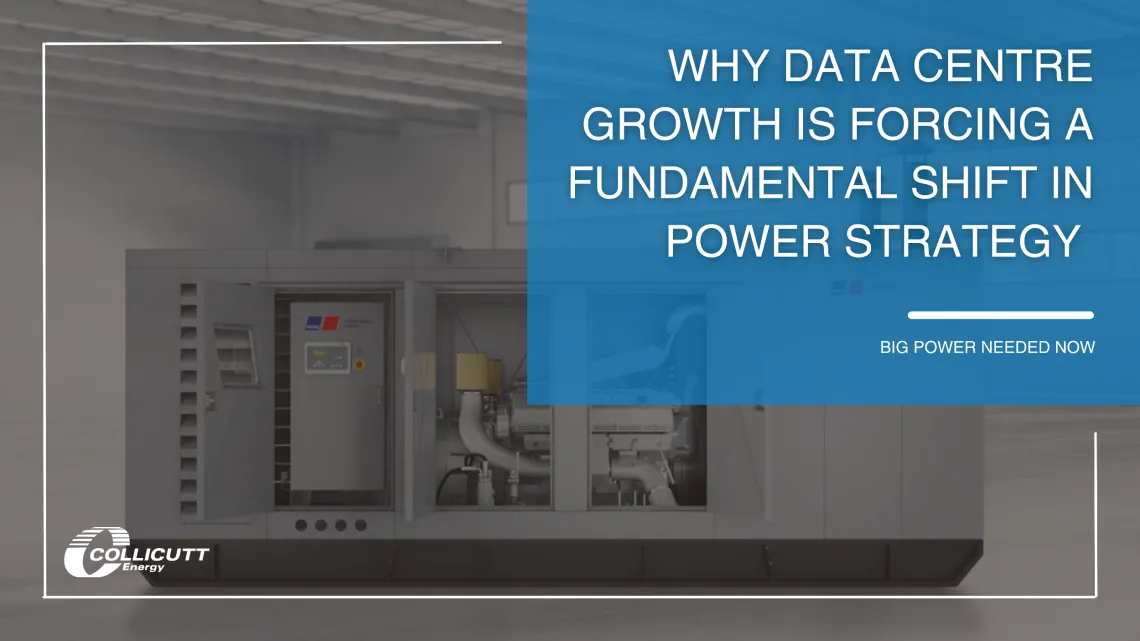
The industry is not facing a demand problem. It is facing a power problem.
Across North America, data centre expansion is no longer constrained by capital, land, or demand. It is constrained by power. Developers are now waiting years for grid interconnection approvals. At the same time, power prices are rising, and other industries are struggling to get grid-connected. This creates a structural bottleneck. Projects that are otherwise viable cannot move forward because power is not available when and where it is needed. The industry is entering a phase where power strategy must be addressed at the earliest stage of development, not as a downstream utility decision.
The scale of demand is outpacing decades of infrastructure.
The pace of demand growth is unprecedented. In Alberta alone, approximately 12 gigawatts of interconnected load took over 80 years to build, and there is, as of November 2025, 20GW of interconnected load requests.
Even if only a portion of these projects are realized, the scale of required infrastructure expansion is clear. This demand is driven by several converging factors:
- Rapid cloud expansion
- Increasing digital infrastructure dependency
- Artificial intelligence workloads that require significantly higher power density
This growth is not linear. It is exponential, and the grid is not designed to respond at that speed.
Why traditional grid reliance is breaking down?
Historically, grid connection was the preferred solution for data centers because it offered reliability, flexibility, and cost efficiency.
However, several limitations are now preventing it from meeting current needs:
- Transmission congestion limits power delivery even when generation exists
- Some regions lack sufficient generation capacity entirely
- Interconnection timelines are no longer aligned with development schedules
- Power pricing is increasing due to supply constraints
These factors are forcing developers to rethink how power is sourced and delivered. Behind-the-meter generation is no longer a backup strategy. It is becoming a primary strategy.
The organization behind the shift.
Addressing this challenge requires integrated expertise. Collicutt Energy Services has spent over 40 years working in the energy sector, with a core focus on reciprocating engine technology.
Our approach is centered on delivering complete solutions that include design, engineering, installation, and lifecycle support. Our partnership with Rolls-Royce Power Systems and the mtu platform brings global scale and proven performance.
The Series 4000 natural gas systems have been deployed thousands of times in data center applications, providing a strong foundation for scalable power solutions.
Natural gas remains the most practical path forward.
While renewable energy continues to evolve, it does not yet meet the requirements for large-scale, dispatchable, and rapidly deployable power.
Natural gas remains the most viable option because it offers:
- Dispatchability
- Reliability
- Faster deployment timelines
- Economic feasibility
Alternative technologies such as wind and solar are non-dispatchable. Nuclear and large-scale combined cycle plants require extended development timelines.
Within natural gas, there are multiple technology paths, including combined cycle plants, simple cycle turbines, and reciprocating engines. Each offers different trade-offs in efficiency, flexibility, and deployment speed.
Reliability is not about equipment. It is about system design.
Reliability is often misunderstood. A single generator operating for 8,760 hours per year with 500 hours of downtime achieves approximately 94 percent reliability.
However, data centres require 99.9 percent or higher availability. This level of reliability is achieved through redundancy and system design, not through a single unit.
By deploying multiple units in parallel and designing for redundancy, system reliability increases significantly. For example:
- A system with insufficient redundancy can result in zero effective reliability for full load
- Adding additional units increases system reliability rapidly
- A properly designed system can achieve 99.9 percent reliability with optimized overbuild
This is where modular engine systems provide a strategic advantage.
AI workloads are redefining power behavior.
Modern data centers do not consume power in a stable way.
Three general load profiles exist:
- Hosting, which is relatively stable
- AI training, which fluctuates periodically
- AI inference, which is highly volatile
AI inference workloads can shift between 30 percent and 70 percent load within minutes. This level of volatility creates a new challenge. Traditional power systems are not designed to respond to rapid and frequent load changes. If generation is directly coupled to this type of load, it can result in system trips and instability.
Battery integration is no longer optional.
To address load volatility, the system architecture must evolve. Instead of protecting the data center from unstable grid power, the system must protect the power plant from unstable load demand.
Battery energy storage systems enable this by:
- Absorbing instantaneous load changes
- Smoothing demand curves
- Allowing generators to operate at stable output levels
In practical scenarios:
- A 50 megawatt battery may be required for moderate volatility
- A 100 megawatt battery may be required for highly volatile AI inference loads
This integration is essential for maintaining operational stability.
Speed to power is now a competitive advantage.
Time is now one of the most critical factors in data center development. Modular power systems allow developers to:
- Achieve first power in approximately 13 months
- Fully deploy systems within approximately 26 months
- Stage capital investment over time
This enables earlier revenue generation and reduces financial risk.
Economic performance favors modular solutions.
When evaluated over a 25-year period, high-speed reciprocating engine systems demonstrate strong economic performance. Key outcomes include:
- Internal rate of return of approximately 17 percent
- Payback period of approximately 8 years
- Higher net present value compared to alternative technologies
These results are driven by:
- Faster deployment timelines
- Reduced overbuild requirements
- Improved operational flexibility
Turbines, while efficient at full load, experience higher fuel consumption at partial load and require higher upfront capital investment.
Space efficiency is no longer a limiting factor.
Power density is only one part of the equation. While large centralized plants are efficient in a single footprint, modular systems offer flexibility in how that footprint is used. Equivalent power can be deployed within similar overall space, but with the ability to distribute units across a site.
This allows:
- Phased expansion
- Adaptation to site constraints
- Reduced risk concentration
Space becomes a strategic variable rather than a limitation.
Designing around real-world constraints.
In theory, infrastructure is designed on clean, rectangular plots with ideal access to utilities. In practice, data center sites are constrained by zoning, geography, access roads, existing infrastructure, and environmental considerations. Real-world sites are rarely ideal.
Modular systems allow developers to:
- Split generation across multiple locations
- Adapt to site limitations
- Maintain centralized electrical integration
This flexibility is critical for projects in constrained or urban environments.
Planning for future grid integration.
A key consideration is long-term strategy. If grid power becomes available in the future, modular systems can be repurposed:
- As peaking plants
- As backup generation
- As grid support assets
- Or redeployed to other locations
This ensures that capital investment retains long-term value.
Engineering the system beyond the generator.
Selecting a generator is only one part of the solution. How the system is packaged, integrated, and deployed ultimately determines speed, cost, and long-term operability.
The first is a modular enclosure design, where the generator and supporting components are integrated into a compact unit. The second is a traditional powerhouse configuration, which provides more space and flexibility for maintenance and long-term upgrades, but requires more on-site construction and time.
Each approach comes with clear trade-offs:
- Modular enclosures enable faster deployment and simpler installation, but can limit maintenance access
- Powerhouse designs allow greater serviceability and customization, but increase construction complexity and timelines
Beyond packaging, system integration is equally critical. Multiple units must operate as a synchronized system, with proper voltage transformation, fuel supply, cooling, and emissions control designed into the overall architecture.
At scale, these systems are built through modular repetition rather than a single large installation:
- 50 megawatt systems can be deployed in modular halls
- 100 megawatt systems scale through multiple connected buildings
- 500 megawatt systems operate as networks of modular plants
This modular approach is what enables both speed and scalability. It allows power to be deployed quickly, expanded over time, and adapted to real-world site constraints without relying on a single fixed design.
Final perspective.
The data centre industry is undergoing a fundamental shift. Power is no longer a supporting utility. It is a core component of project feasibility.
Behind-the-meter generation, supported by modular design and battery integration, is becoming the foundation for scalable and reliable data center growth.
Real-world considerations and technical depth.
The final discussion reinforces key operational considerations:
- Noise management from large-scale radiator systems
- Hydrogen blending capabilities up to 20 percent with future expansion potential
- Deployment timelines and supply chain realities
- Control system complexity and cybersecurity requirements
These factors highlight that while the technology is proven, successful implementation requires careful engineering and planning.
The grid will remain important. However, it can no longer be the only strategy. The organizations that move first will not wait for power to become available. They will build systems that ensure it already is.
April 29, 2026
